Welcome to UBIYA DERMA

By Rajendra Koirala, BSc (Chemistry), MBA — Founder & Managing Director, Ubiya Derma; Cosmeceutical Formulation & Product Development Specialist.
About the author: Rajendra Koirala brings 20 years of pharmaceutical industry experience to Ubiya Derma’s product development. He writes practical, research-informed skincare articles for readers in Nepal.
Prepared for Ubiya Derma. Editorial update: 8 November 2026. General skincare education; not medically reviewed.
A niacinamide listing tells you that the ingredient is in the formula. Unless the percentage is explicitly disclosed, it does not tell you the amount. Ingredient presence alone also does not tell you how the finished cream was tested or what result you will see. Research on niacinamide can help you ask better questions, but a study of one preparation cannot validate every retail product that names the same ingredient.[1]
This distinction matters when you compare a day cream, a serum and a face wash in a Nepal online shop. They can all mention niacinamide while differing in purpose, other ingredients, contact time and directions. Start with the whole product and the problem you want to solve. Then use the ingredient list as one part of the decision, not a promise on its own.
Niacinamide is a form of vitamin B3. A scientific review describes evidence for cosmetic uses including skin-barrier support and improvements in uneven-looking tone, while emphasizing how formulation affects delivery.[1] That explains why the ingredient appears in different skincare formats. It does not make a cleanser, serum and day cream equivalent.
Before studying a highlighted molecule, ask whether you are buying a rinse-off cleanser, a leave-on moisturizer, a sunscreen or a treatment recommended by a clinician. A cleanser is used and washed away; a day cream stays on the skin. Even when both contain niacinamide, they are not interchangeable steps. The directions and product type are more useful than a headline saying “with vitamin B3.”
For a crowded Kathmandu morning, a clear question might be: “Do I need a moisturizer that fits comfortably before sunscreen?” That question points you toward texture, directions and routine fit. If your concern is a persistent rash, painful irritation or a diagnosed condition, an ingredient comparison is not a substitute for individual medical advice.
Check whether the brand describes the finished item accurately. Look at its purpose, complete ingredient list, warnings, pack size and use instructions on the current official page and pack. An older reseller image can show a different presentation. If the web listing and the physical packaging disagree, ask the seller or brand to clarify before drawing conclusions.
A 2024 scientific review discusses niacinamide's use in topical formulations and the importance of delivery strategy.[1] It gathers evidence across different contexts and preparations. That is a useful starting point for understanding why formulators use the ingredient; it is not a test report for a Ubiya product or a universal concentration recommendation.
When a brand cites a study, check the tested preparation, concentration, comparison and duration. If these differ from the item you are considering, the result cannot simply be transferred to it. You do not need to review an entire research paper to ask the brand for those details.
The full formula matters because ingredients work within a product that also has a vehicle, stability requirements and application instructions. You cannot read a clinical result straight off the front label. Likewise, the order of ingredients is not a reliable substitute for a disclosed percentage or a finished-product study. If the brand does not state a concentration, leave it unknown.
Purpose: which step is this product for?
Full formula: what else is listed, and is this the current pack?
Directions: how and when should I use it?
Evidence: was this finished product tested, or a different preparation?
Fit: does it add a function I need?
Save a photo of the current pack and write down the question that led you to consider it. This small record is especially helpful when several online listings use the same familiar ingredient names. A prominent “niacinamide” label can attract attention; the five checks reveal whether the product itself answers your need.
If a claim says “clinically proven,” look for the specific study, tested formula, comparator and outcome. If those details are unavailable, treat the wording as an unverified claim. Avoid assuming that a percentage seen on another brand's serum applies to this cream. Also avoid stacking several products solely because each advertises the same ingredient.
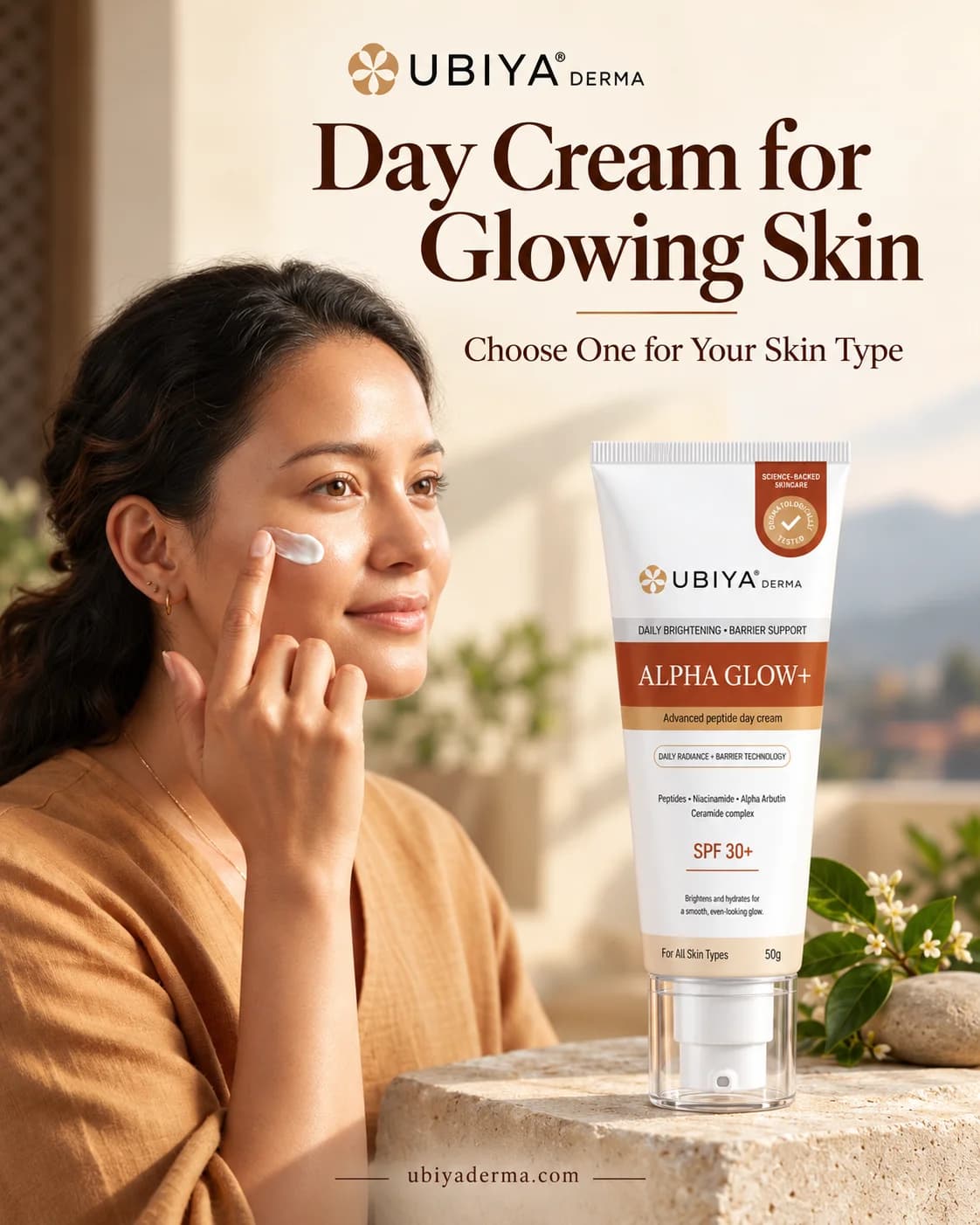
Ubiya Derma's Alpha Glow+ Day Cream currently names niacinamide, alpha arbutin and ceramides and describes itself as a moisturizing day cream for dull, uneven-looking skin.[2] The verified live page establishes those listing facts. It does not independently establish an ingredient percentage, a clinical outcome or a comparison with procedures. Read the current package and directions before deciding whether the cream fits your routine.
If you already use a moisturizer you like, ask what the new item adds. You might need no new product. If you want a day cream, compare texture, use instructions and compatibility with the sunscreen you will apply separately. The AAD's general routine places moisturizer and/or sunscreen before makeup.[3] This example is a way to practice label reading, not a prescription for a pigmentation condition.
No general rule follows from the number alone. The complete formulation, intended use, tolerability and evidence for the particular claim matter. Do not infer a percentage when it is not disclosed, and do not assume that the largest number is the best fit for your skin.
No. Ingredient presence does not establish a measured result for the finished cream or diagnose the condition of your skin. Compare the product's intended cosmetic purpose and evidence. If discomfort persists or you suspect a medical problem, seek qualified advice.
First ask which unmet need the extra step would address. Duplication is not automatically useful. Follow each product's directions and seek personal advice if you have a prescribed routine or recurrent irritation.
Both can list the ingredient, but the products have different contact times and functions. Research or claims about one format do not automatically transfer to the other. Evaluate each finished product separately.
The best label question is not “Does it contain the trending molecule?” It is “What job should this exact product do, and what evidence supports that job?” Verify the pack, directions and full formula; treat unspecified details as unknown. That is a more dependable way to compare products than using a single ingredient name as a result guarantee.
Niacinamide: a review on dermal delivery strategies and clinical evidence, Drug Delivery and Translational Research (2024).
Ubiya Derma Alpha Glow+ Day Cream, official live listing checked 8 November 2026.
American Academy of Dermatology, Should I apply my skin care products in a certain order?.