
Welcome to UBIYA DERMA
By Rajendra Koirala, BSc (Chemistry), MBA — Founder & Managing Director, Ubiya Derma; Cosmeceutical Formulation & Product Development Specialist.
About the author: Rajendra Koirala brings 20 years of pharmaceutical industry experience to Ubiya Derma’s product development. He writes practical, research-informed skincare articles for readers in Nepal.
Prepared for Ubiya Derma. Editorial update: 8 November 2026. General skincare education; not medically reviewed.
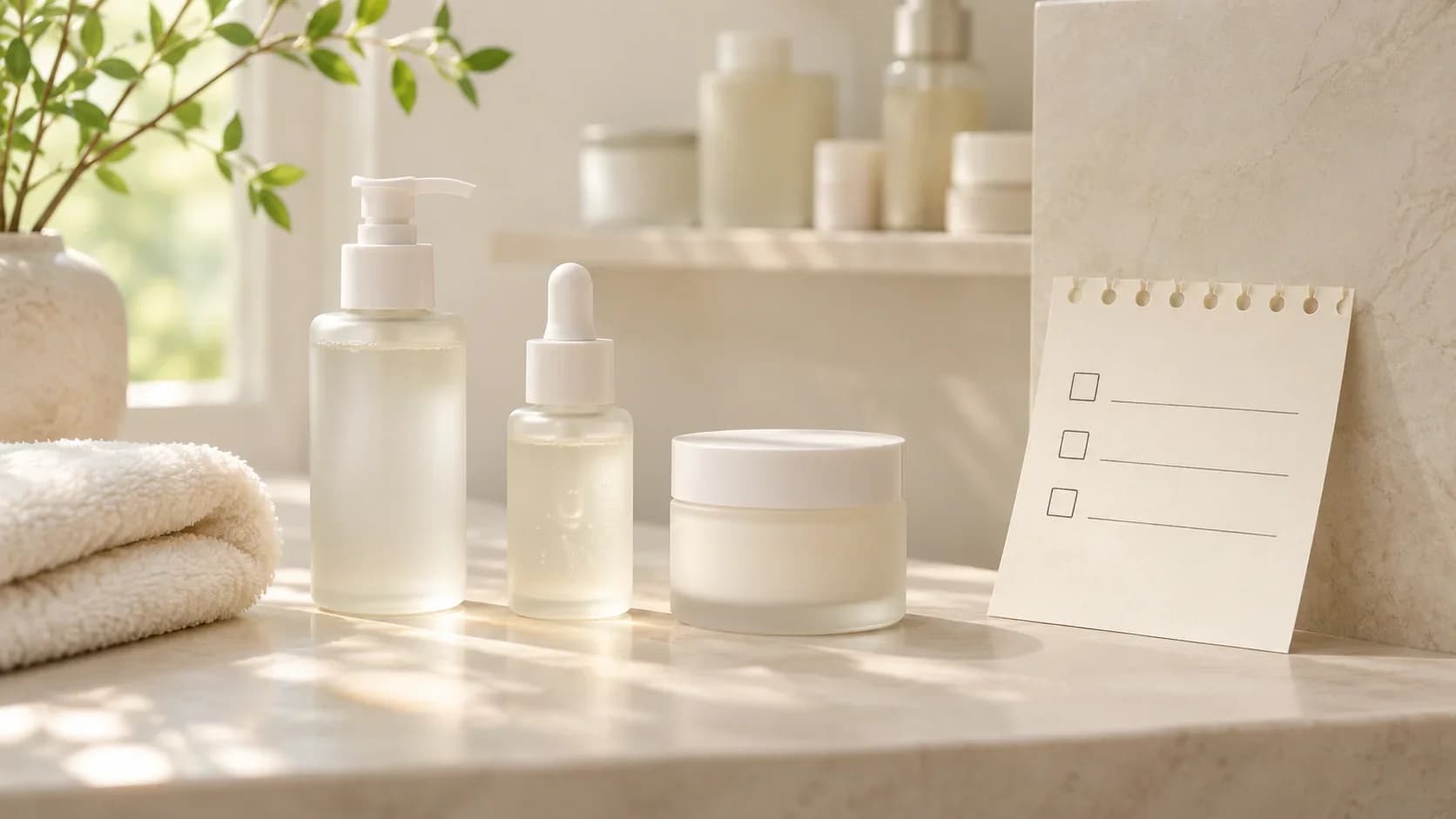
If your routine has grown into several serums, exfoliants and creams, write down every step and its purpose before adding another product. Keep prescribed treatments under your clinician's instructions. For optional cosmetics, identify overlapping jobs, follow each label and change one thing at a time. The American Academy of Dermatology (AAD) warns that using several anti-aging products at once can irritate skin and recommends starting with one new product.[1]
This guide solves a common problem: the bathroom shelf has expanded, but you can no longer say which bottle does what. It is a method for organizing an everyday routine, not a diagnosis or a treatment schedule. A Kathmandu shopper may see several products advertised for “glow,” “barrier” and “renewal”; those words can overlap even when the formulas and directions do not.
Gather the actual bottles, tubes and current product pages. Include cleansers, leave-on products, sunscreen, occasional masks and anything applied only at night. Record the product names exactly as printed and check whether you are looking at an old or new pack. A saved social-media recommendation is not a substitute for the directions on what you own.
Separate products you use because a clinician prescribed them. Do not stop, combine or change the timing of prescribed treatment based on an online article. If its instructions appear to conflict with another product, ask the prescriber or pharmacist. Your cosmetic inventory can make that conversation easier because it shows everything that touches your skin.
Now ask what each optional step contributes. “I bought it because it went viral” is an honest answer, but it is not a skin need. “This is the moisturizer that keeps my routine comfortable” is more specific. The aim is to make the daily sequence explainable, not to reach an arbitrary number of bottles.
Product: write the exact name.
Purpose: state the job it does, such as cleansing, moisturizing or sun protection.
Directions: copy the amount, contact time and precautions from the current label.
Timing: record when and how often you actually use it.
Status: identify whether it is prescribed or an optional cosmetic.
Answer these questions for each item, even if two look nearly identical. Repeated purposes show where to investigate overlap. Missing directions show which label to read before changing anything.
Add a note about the date you introduced each item. It is difficult to identify the source of a new uncomfortable feeling when three products began on the same evening. The AAD advises testing a skincare product before incorporating it and following its instructions.[2] A simple record does not prove causation, but it makes the routine more understandable.
Two products can have different hero ingredients and still aim at the same job. One “brightening” serum, another “tone” cream and an exfoliating step may all be competing for space in the same evening. Conversely, a moisturizer and a sunscreen have different principal purposes even if both feel creamy. Compare product function and use directions before deciding what is redundant.
Take extra care when exfoliation is involved. The AAD notes that certain medicines and over-the-counter products can make skin more sensitive or peel, and that exfoliating alongside them may worsen dryness or breakouts.[3] That guidance supports reviewing combinations; it does not supply a universal timetable for your particular actives. Avoid copying a fixed “one day acid, next day retinoid” schedule from a trend post when your own products or prescription say otherwise.
If you feel stinging or burning, do not keep adding more products to compensate. The AAD advises stopping a cosmetic product that causes such irritation, while checking with a dermatologist before changing a prescribed item that may cause an expected sensation.[1] Persistent or severe symptoms need professional evaluation. This article cannot tell which ingredient caused them.
Choose one practical question: Which optional step is doing a job I cannot otherwise explain? Compare its label with similar items. If you decide to remove an optional cosmetic, note the change and keep the rest of the routine as consistent as practical. Do not alter multiple variables simultaneously and then credit one ingredient for a better day.
A basic morning often has a clearer purpose than a crowded one: gentle cleansing as needed, a suitable moisturizer if needed, and sunscreen according to its directions. The AAD's general ordering advice places moisturizer and/or sunscreen before makeup.[4] A simple routine still needs the right amount and application of sunscreen; fewer steps do not excuse skipping protection.
Your evening may be different because of prescribed treatment or personal preferences. Keep those instructions in the audit. If you want to reintroduce an optional product, read its label and consider the AAD's product-testing guidance.[2] The goal is repeatability and clarity, not an experiment that pushes your skin through every new ingredient this month.
Before browsing the Ubiya Derma range, complete your audit. Keep a moisturizer and sunscreen in their intended roles, then ask which optional product supplies a function you still need. For the sequence of products, see our serum-layering guide.
There is no universal winning number. The useful test is whether every step has a purpose, follows its directions and fits comfortably with prescribed care. More products do not automatically mean better results, and excessive layering can complicate troubleshooting.[1]
Do not change a prescribed retinoid from this article. Record the exact products and ask the treating clinician about overlap or irritation. For over-the-counter cosmetics, read directions and review whether you need both.
Follow the exact product directions and consider the rest of your routine. The AAD says exfoliation is not for everyone and the right approach depends on skin type and other products used.[3] A gentle-sounding label is not a personal treatment plan.
Keep a list of products, start dates and symptoms and seek a qualified dermatologist's assessment. An online checklist cannot diagnose an allergy or other condition. The AAD notes that identifying the cause may require professional help.[2]
Take ten minutes to answer the five questions, then read the missing labels. Preserve the steps with clear purposes and instructions. Ask a professional before changing prescribed care. When an optional product has no distinct role, you have a concrete question to resolve before you spend more money or add another active.
American Academy of Dermatology, How to maximize results from anti-aging skin care products.
American Academy of Dermatology, How to test skin care products.
American Academy of Dermatology, How to safely exfoliate at home.
American Academy of Dermatology, Should I apply my skin care products in a certain order?.
Ubiya Derma, Pigmentation routine and serum layering, checked in CMS 8 November 2026.